Zagreb among Top 15 in Europe for lowest poverty and social exclusion risk
- by croatiaweek
- in News

(Grad Zagreb/Eurostat)
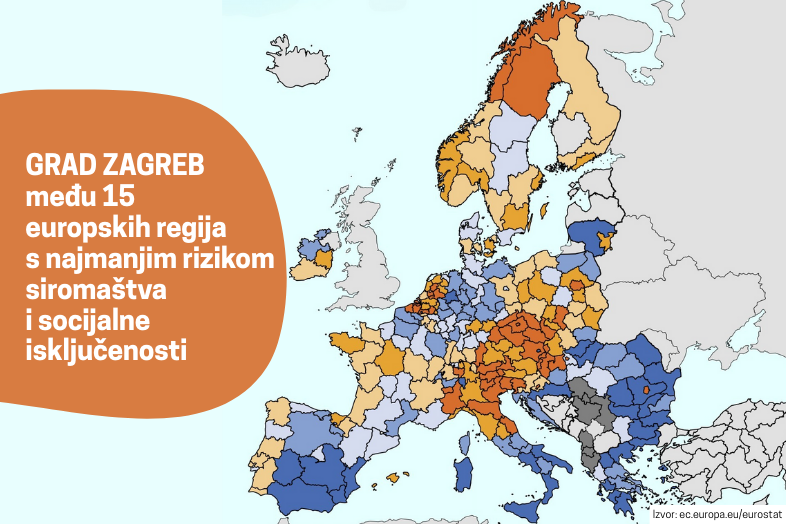
According to the latest data from Eurostat, the Croatian capital Zagreb has been ranked among the 15 European regions with the lowest share of population at risk of poverty or social exclusion, placing it well above the majority of regions across the European Union.
Out of 244 European regions classified under the EU’s NUTS2 system, 11.1 per cent of Zagreb’s population was identified as being at risk in 2024.
This represents a notable improvement, with Zagreb climbing 11 places compared to its position in 2021.
Mayor Tomislav Tomašević said the figures confirm that Zagreb is moving in the right direction, particularly at a time of global uncertainty and declining social trust.
“Our goal is to achieve a high level of social cohesion in Zagreb. These data show that we are performing better than most EU regions, and our efforts were also recognised in 2024 when Zagreb was named the European Capital of Inclusion and Diversity,” Tomašević said.
However, the Eurostat data also highlights significant disparities within Croatia. While Zagreb performs strongly, other regions lag far behind.
In Northern Croatia, 18.3 per cent of the population is at risk, placing the region 110th in Europe. Adriatic Croatia records a rate of 22.9 per cent, ranking 174th. The situation is most concerning in Pannonian Croatia, where the share rises to 31 per cent, placing it 218th, among the worst-performing regions in the European Union.
Pannonian Croatia includes the counties of Bjelovar-Bilogora, Virovitica-Podravina, Požega-Slavonia, Brod-Posavina, Osijek-Baranja, Vukovar-Srijem, Karlovac and Sisak-Moslavina.
Mayor Tomašević also noted his expanded role at the European level.
(Grad Zagreb/Eurostat)
“Last year, I took on the role of shadow rapporteur for social issues within the Eurocities network, alongside the Mayor of Florence, Sara Funaro. This allows us to actively contribute to shaping European policies aimed at reducing poverty and strengthening social cohesion,” he said, adding that the city continuously monitors living standards and adjusts services accordingly.
The indicator “risk of poverty or social exclusion” refers to people who are severely materially and socially deprived, or who live in households with very low work intensity. Each individual is counted only once, even if they meet multiple criteria. It is the main indicator used by the EU to track progress towards its 2030 poverty reduction targets.
Deputy Mayor Danijela Dolenec stressed that accessible public services remain the most effective tool in addressing poverty and exclusion.
“High-quality and widely available public services are essential, from kindergartens and social services for older residents and people with disabilities, to a strong network of primary healthcare. Everyone needs support at some point in life, whether due to illness, unemployment or other circumstances,” Dolenec said.
She added that Zagreb aims to maintain a dense and responsive support network so residents can more easily overcome difficult periods in their lives.
The full Eurostat report is available here.