Listening to Croatia’s miraculous voice of nature – Ljubo de Karina
- by croatiaweek
- in Entertainment
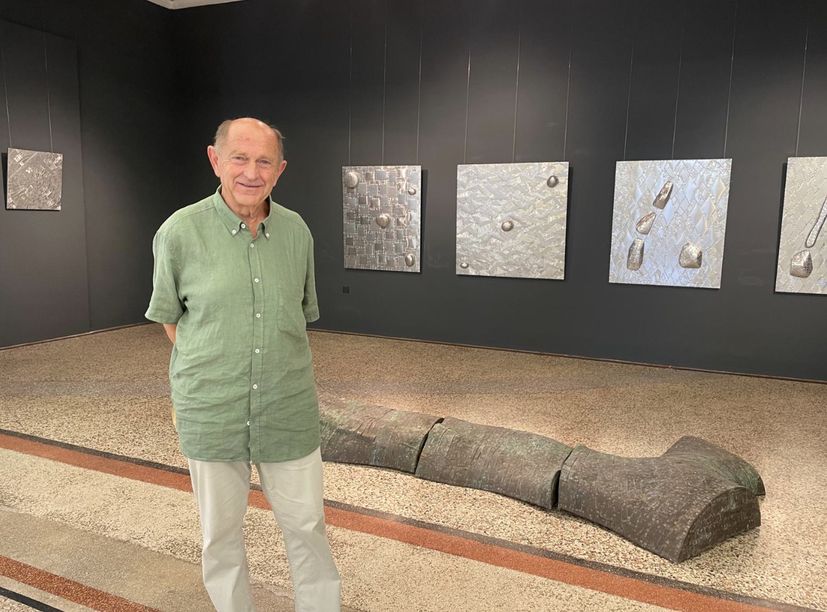
The artist Ljubo de Karina at the exhibition
by Vicki Sussens
Croatia has a lyrical coastline. As the art historian Vladimir Goss describes it: “Throughout thousands of years, man has listened to this miraculous voice of nature, discovering dreams and visions engraved into the landscape.”
That “miraculous voice of nature” has influenced the Croatian sculptor Ljubo de Karina, whose latest exhibition opened on 17 July in the Juraj Šporer Art Pavilion in Opatija. Hosted by the Opatija Festival, it runs until 7 October 2025.
The exhibition comes two months after the 77-year-old artist opened to the public his sculpture park, which surrounds his clifftop home in Brseč. It has been a while since he has been in the public eye.
De Karina is as famous for his sculptures as he is for the extraordinary homes and landscapes that house his works. One is in Brseč, where he was born, the other in the nearby village of Zagore, where he has his gallery.
“Brseč is my spiritual home. I would be lost without it,” he says. He once told a filmmaker he did not need to go to Artschool to learn how to sculpt, (although he did in the end), because the landscape was already forming him.
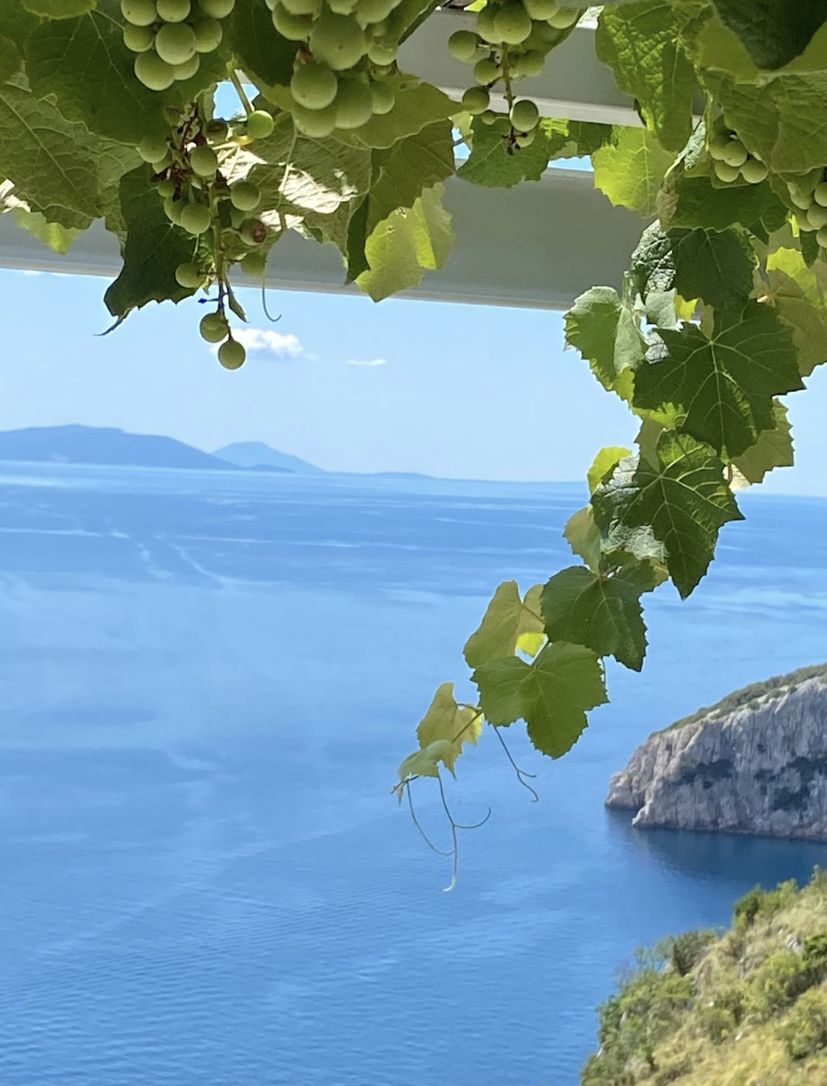
View from de Karina’s home in Brseč
But he has also absorbed the thousand-year-old dreams of his forefathers, the Slavs and Liburnians, as well as the visions of the region’s many occupiers – all of whom left a rich stone legacy.
His latest exhibition is an ode to wood, an historic material used to make our earliest homes but also to create icons to our gods. Each piece of carved wood is a work of art, but the viewer does not get to see the wood. It is clad in metal, also an archaic material.
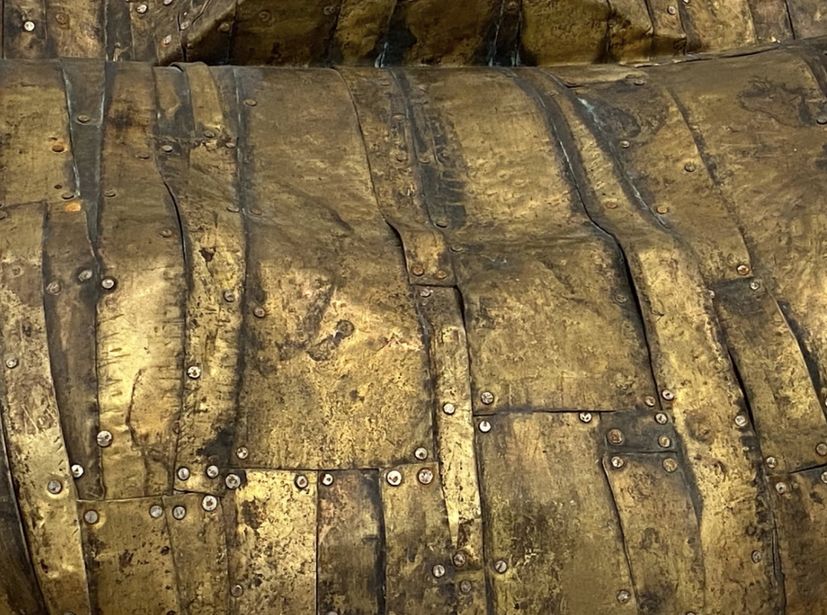
Coated soft shape, 1991
“The metal protects something very precious,” says the artist. In his youth in Brsec, where people struggled to make a living, they nailed metal strips onto broken doors or window frames. This was an early inspiration for him.
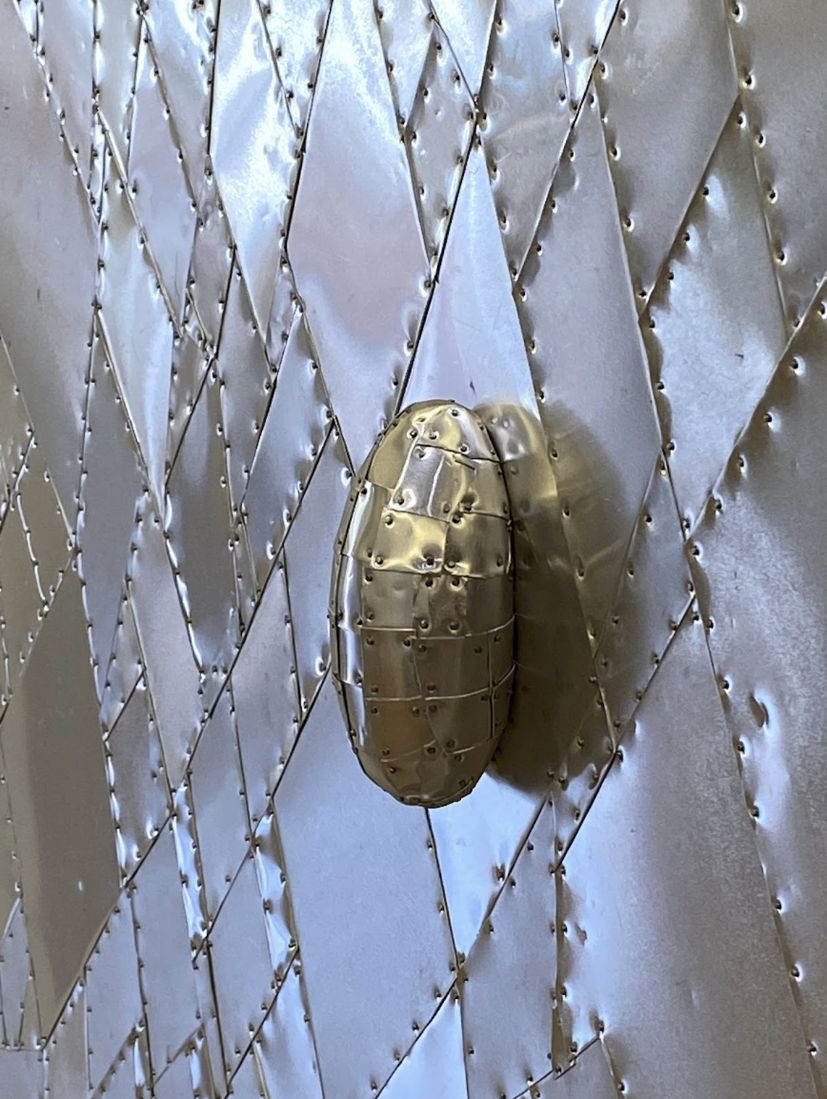
The exhibition shows how de Karina’s work has evolved. The walls are hung with his latest works. The aluminium pieces are stitched together with hundreds of tiny nails. They reflect light, and the more you look at them, the more you see. Most have objects attached to them.
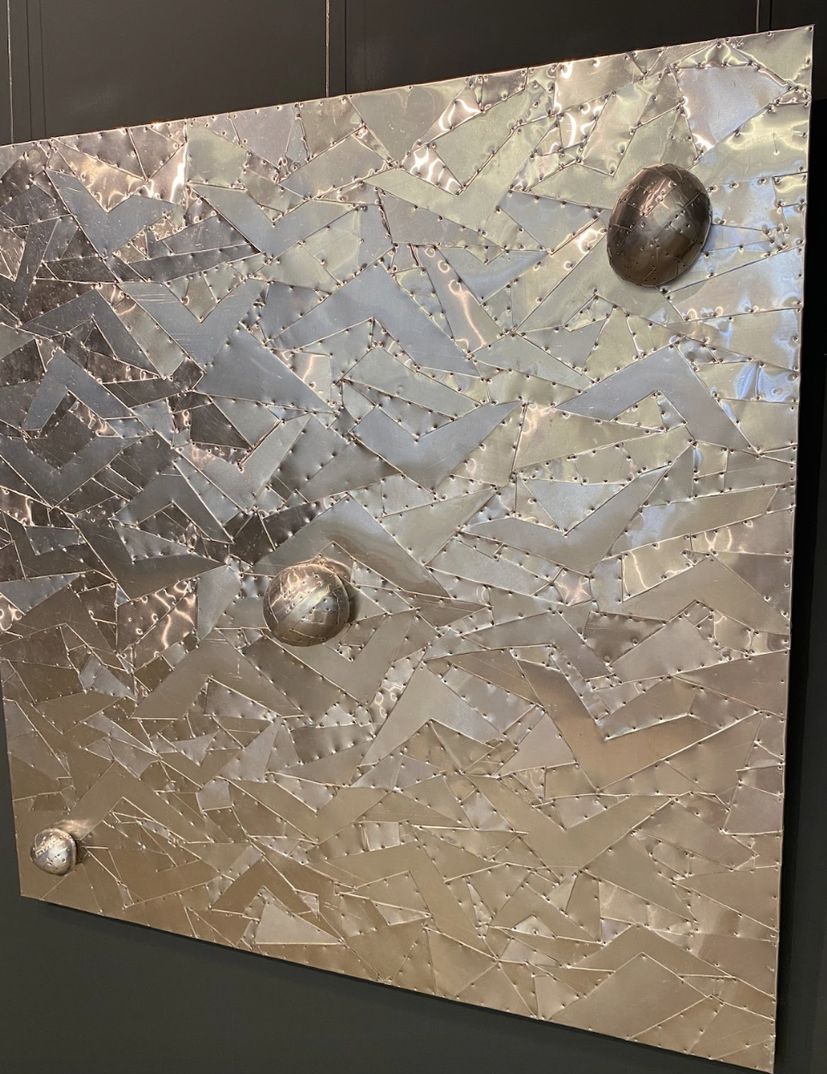
Orion’s Belt
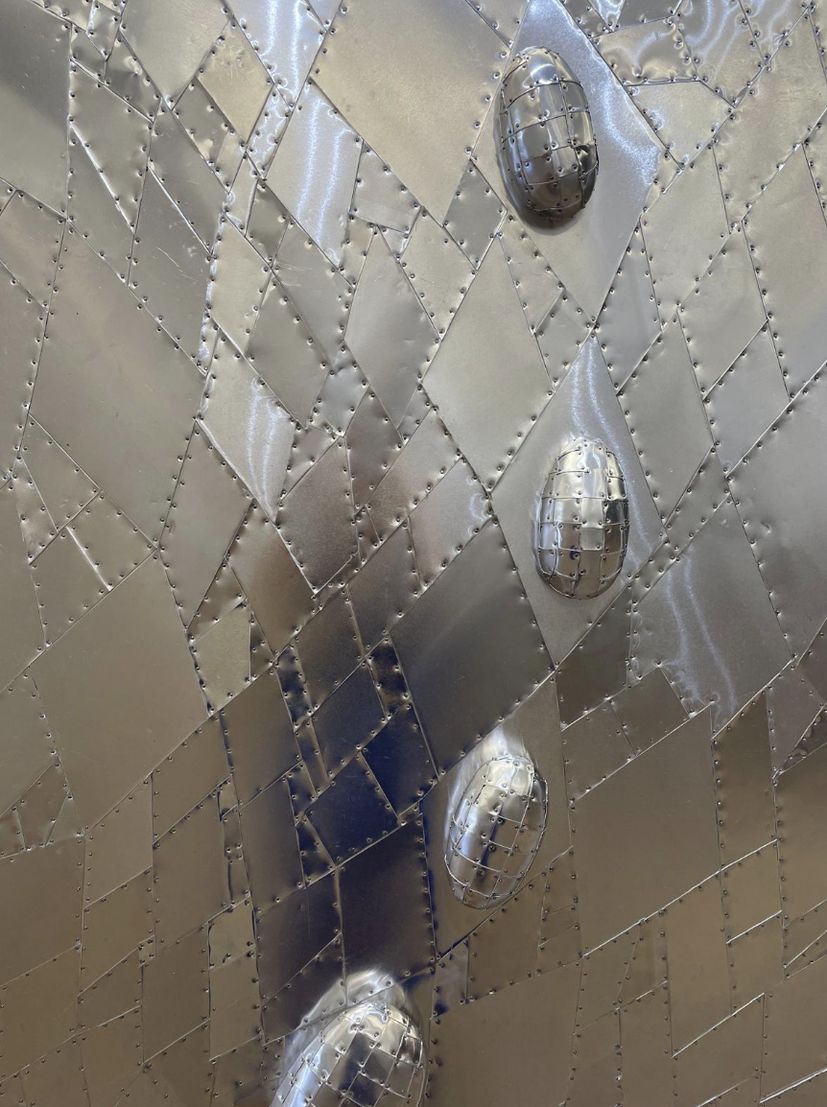
The theme of his latest works is death and renewal, he says. “We look at the night sky and find it beautiful because of the stars. And although it takes us into darkness, we sense a rebirth. This is the eternal cycle of life reflected in my works, which at first, show only beauty.”
The floor is dedicated to his earlier objects, now darkened by age. They include a massive, metal clad tree trunk, which forms a heavy figure lying with its head facing east.
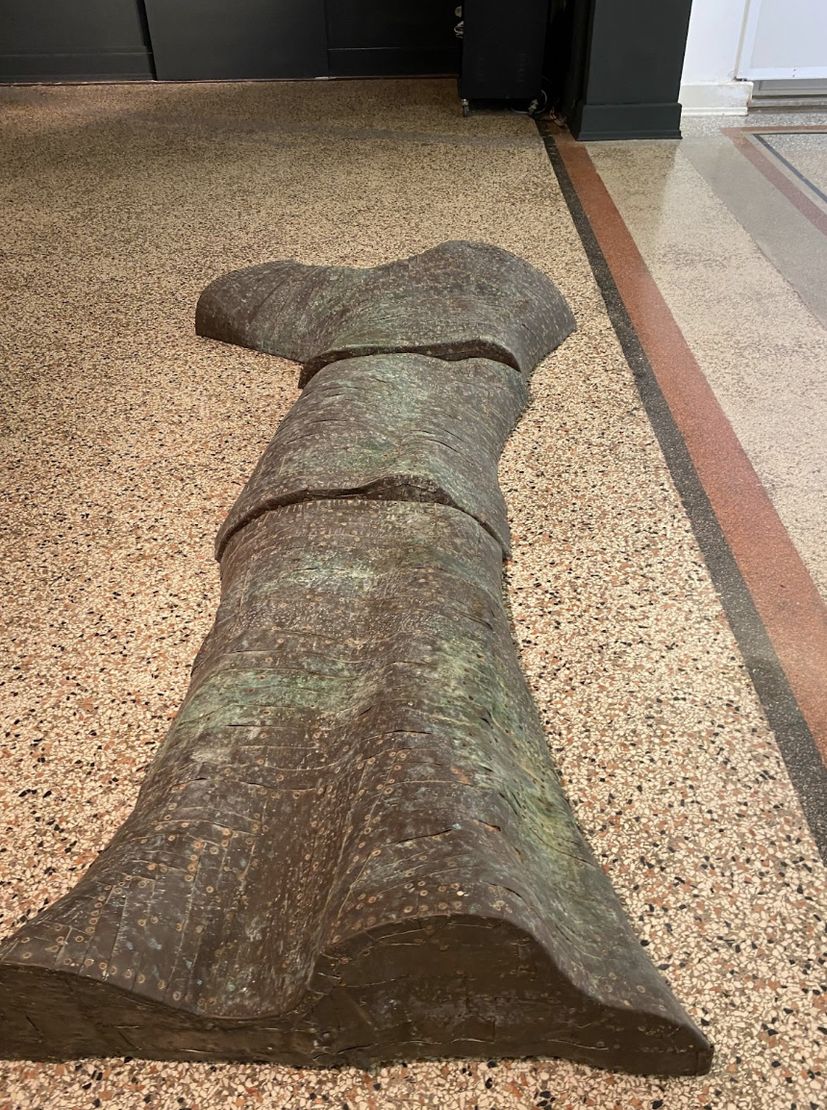
Mummified tree, 1998
Taking centre stage, and framed by floor decorations, is a circle of metal-clad pebbles – also carved from wood. The woman who cleaned the exhibition hall stares at them and says: “They remind me of the stones on the beach in Pag, where I spent my summers with my grandparents.”
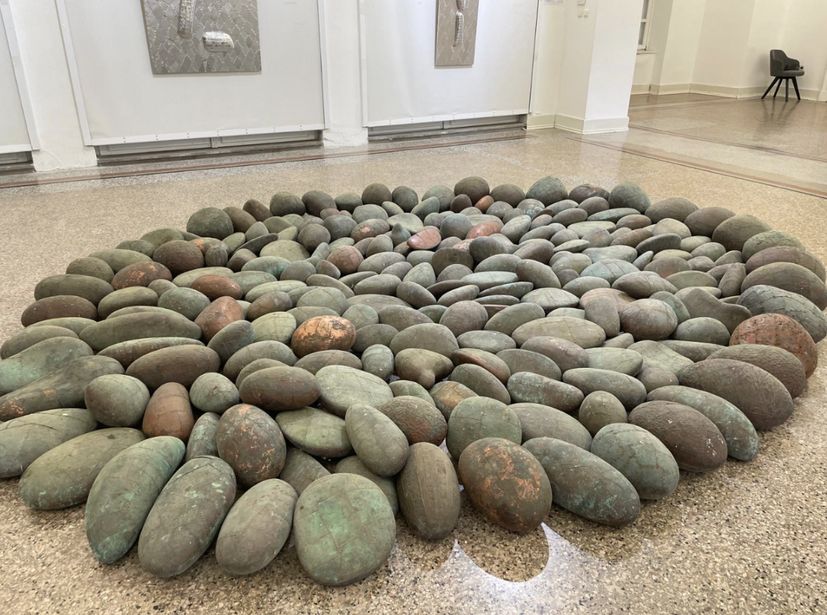
And this is de Karina’s greatest gift. His art speaks to something deep within us – something deeply connected to nature and our life within nature. As Ernie Gigant Deskovic, writes in the exhibition catalogue: “We enter the world of the artist who mercilessly pushes us to the edges of understanding.” This quality has turned de Karina into one of Croatia’s most important living artists.
“De Karina explores layers of memory. He delves into the ancient, prehistoric essence of primary pre-urban sensations and forms,” says the art historian Goss, who is also Emeritus Professor at the University of Rijeka. “His work is always deeply mystical.”
The exhibition curator Branka Arh in her opening speech said that Karina’s sculptural language has developed over almost four decades into a “firmly established and consistently thought-out visual language. The works … testify to a deep reflection on the relationship between form, space and meaning.”
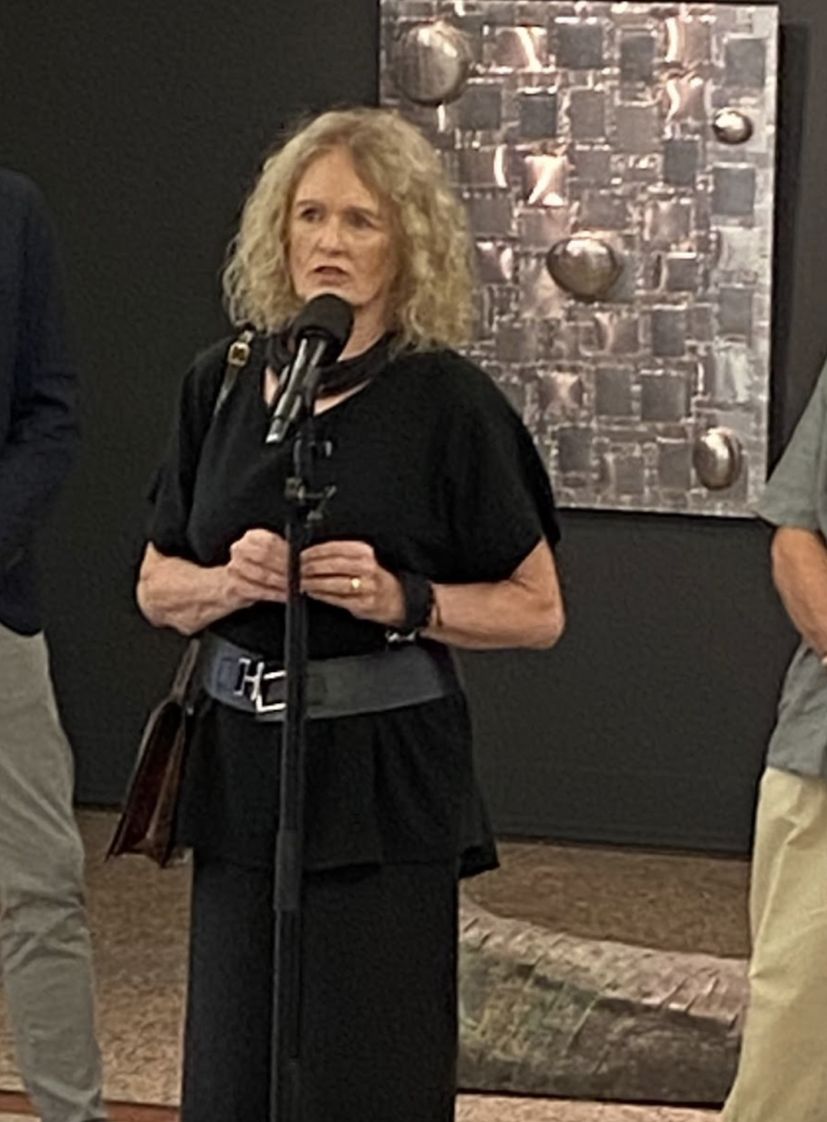
Curator Branka Arh at the exhibition opening
Although the exhibition is dedicated to his metal-clad objects, de Karina is also famous for his works in stone.
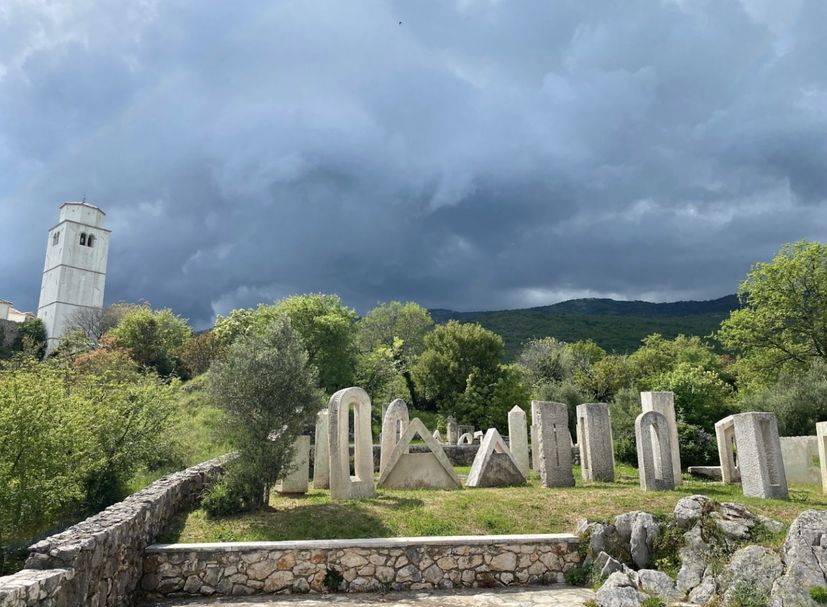
“Stone has always played a role in life here, where there are still traces of the Neolithic era,” he says. “I am very aware of this when I sculpt a stone that may be millions of years old. In fact, I like to think of my work as a Neolithic interpretation.”
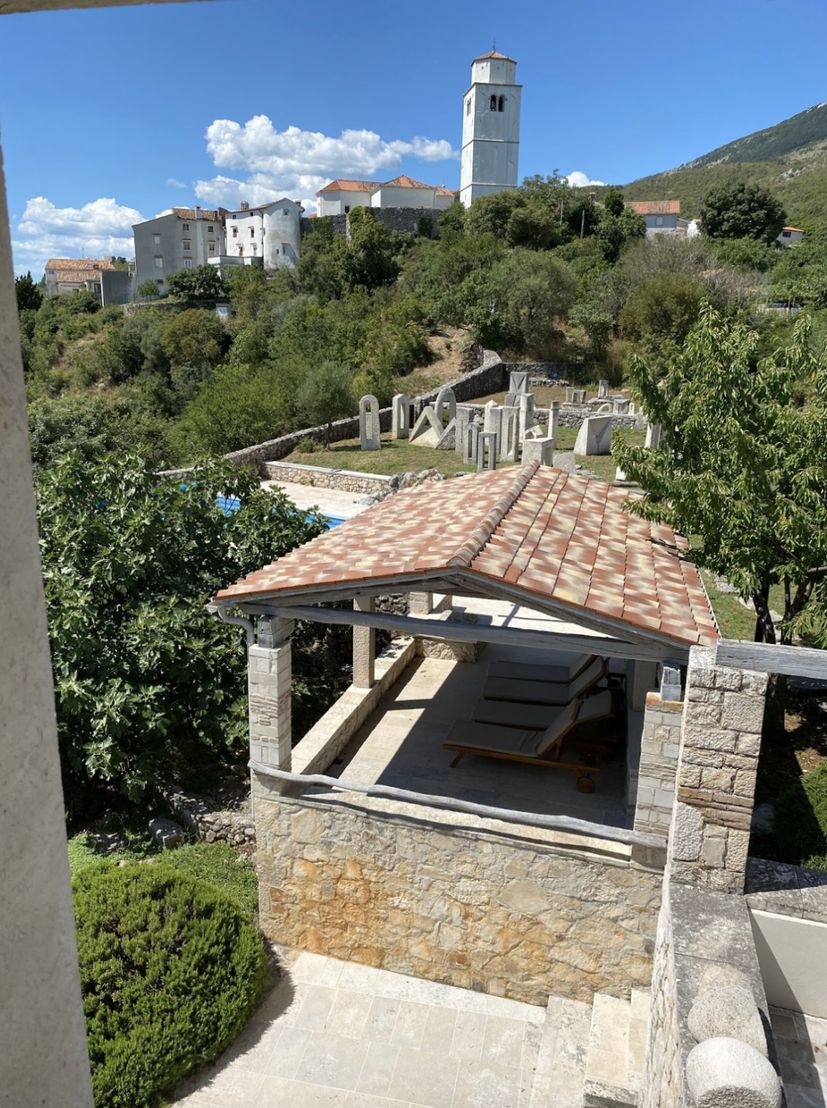
De Karina’s “penetration” sculptures at his home in Brsec
Many of the works in his sculpture park are a homage to the ancient Slavic Gods. From here, one can see Mount Perun – one of thousands of holy mountains, ponds, rocks, and rivers the early Slavs dedicated to their gods. Perun is a ruling god of, among other things, the sky, lightning, storms and fertility. He is in constant battle for the favours of the sun with Veles, the Slavic God of earth, water and the underworld.
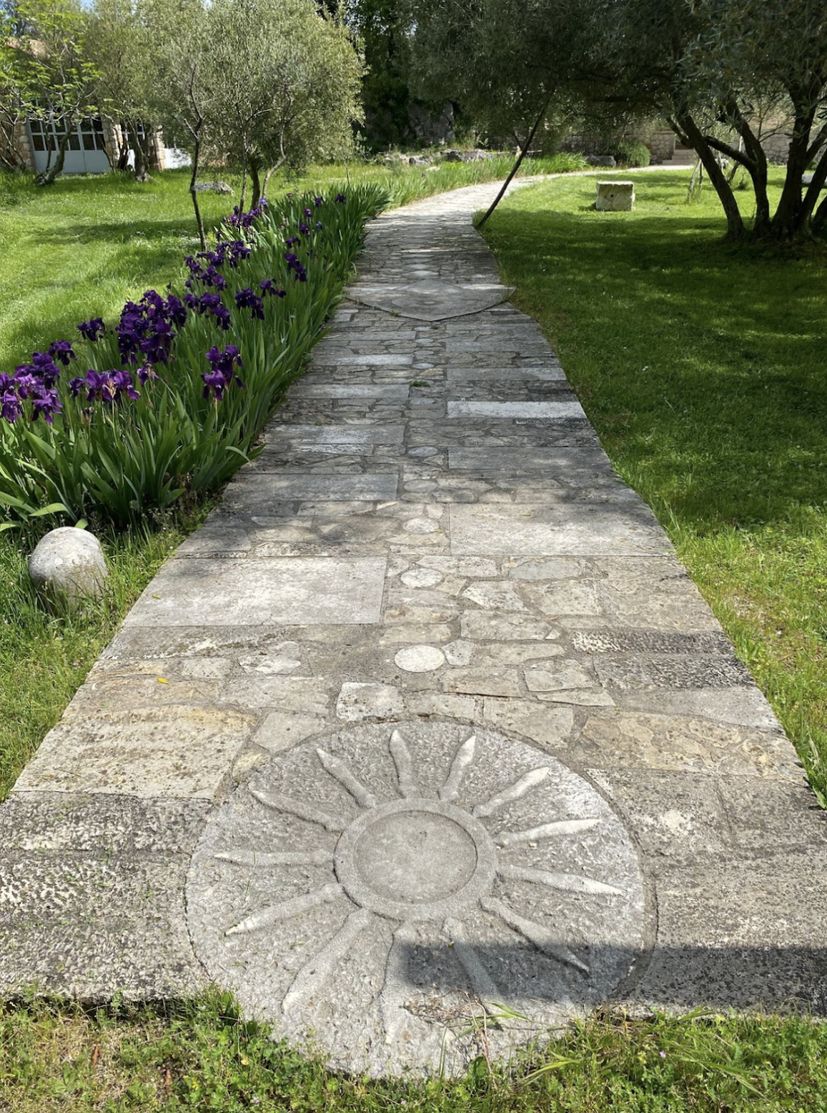
A path dedicated to the struggle between darkness and light
De Karina has created a stone path to his front door dedicated to this battle. In direct line with Mount Perun, it starts with the sun then winds to his front door in the form of a long paved snake, one of the symbols for Veles.
As we enter an era of darkness and an unhealthy scramble for power, de Karina’s works remind us to look to the timeless values, visions and voices of the past.
About
Ljubo de Karina was born in Rijeka in 1948. After studying at the Academy of Fine Arts in Ljubljana, he trained in the ateliers of Vanja Radauš and Anton Augustinčić. Since 1973 he has been working as an independent artist.
He has held numerous solo exhibitions in Croatia and abroad, and his monumental works can be found in public spaces and collections throughout Europe.
Among his most significant achievements are the bronze doors of the Cathedral of St. Vitus in Rijeka, the funeral monuments of Cardinal Josip Uhač and Mons. Anton Benvin, as well as the installations of the Glagolitic Trail in Baška and Tramuntana I in Cres.