Roman stones, hot springs and mud: Discover Topusko, Croatia’s unusual spa town
- by croatiaweek
- in Travel

(Photo: Paulina Mlinarić)
By Paulina Mlinarić
Roman traces, thermal springs and rare mud baths found in only a handful of places in Europe
Some places preserve their past in museums, behind glass and thick walls. Others have history simply standing before you, in stone, water, old buildings and traces left by people who lived there centuries ago.
Topusko belongs to the latter.
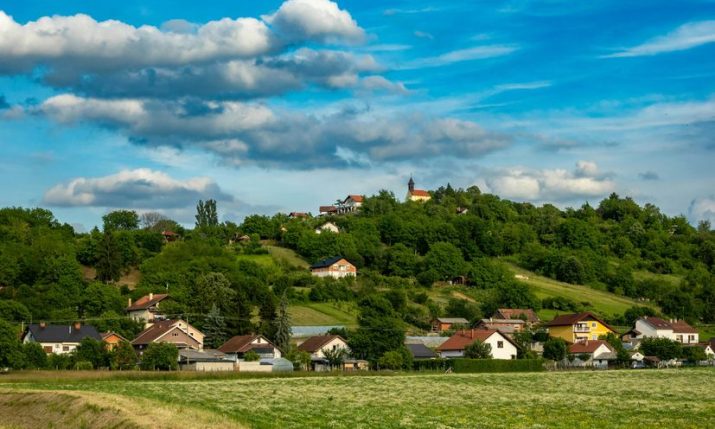
Set amid the greenery of Banovina, not far from Zagreb, Sisak and Karlovac, this small town hides an unusual combination of Roman heritage, thermal springs, a centuries-old spa tradition and nature that gives it a character all of its own.

(Photo: Paulina Mlinarić)
Stand before one of its Roman altars and look at stone that has survived almost 2,000 years, and suddenly Topusko begins to look very different.
The Romans left their mark
The story of Topusko did not begin with the modern spa.
Its thermal waters were attracting people as far back as Roman times, when a settlement developed in the area. Archaeological discoveries point to a community that was considerably more developed than one might expect from today’s peaceful town.
Coins, parts of buildings, funerary monuments, jewellery and other artefacts have been discovered, but among the most intriguing are the Roman altars.

(Photo: Paulina Mlinarić)
Particularly notable are those dedicated to Vidas and Thana, a divine couple associated with the area, as well as Silvanus, the Roman god of nature and forests.
These stone remains give Topusko something that cannot be created through a tourism slogan, a genuine sense of continuity.
On the same ground where visitors now come for thermal waters and relaxation, people almost two millennia ago had their own gods, customs and everyday lives.
And water was one of the reasons why the area was important.
The water that shaped Topusko
The thermal springs have remained Topusko’s greatest natural asset for centuries.
The water emerges at temperatures reaching as high as 68°C, while the springs have a combined yield of more than 200 litres per second.

(Photo: Paulina Mlinarić)
It is not difficult to understand why the thermal waters have played such an important role in the development of the town.

(Photo: Paulina Mlinarić)
Topusko flourished particularly as a spa destination in the 19th century. Bathing facilities, parks and promenades were developed, giving the town a new dimension and attracting visitors seeking the therapeutic properties of the water as well as relaxation.

(Photo: Paulina Mlinarić)

(Photo: Paulina Mlinarić)
Today, wellness is associated with modern hotels, spa centres and swimming pools.
In Topusko, however, the story began much earlier and, perhaps most interestingly, its main “spa centre” was created by nature itself.
The water was bringing people here long before wellness became a tourism trend.

(Photo: Paulina Mlinarić)

(Photo: Paulina Mlinarić)
And then there is the mud
An important part of Topusko’s story is its peat and peat-mud baths.
They are part of the spa tradition that gave the area another distinctive feature. According to information from the Topusko Spa, such mud baths are very rare by European standards, while the thermal water and natural peloid have for decades been an important part of the town’s spa offering.
That makes it difficult to describe Topusko simply as a thermal destination.

(Photo: Paulina Mlinarić)
Here, the story of the water naturally leads to the story of mud, with both deeply connected to the development of the town.
Nikolinom Brdo reveals another layer of history
Topusko is not a destination to be rushed.
One interesting area to explore on foot is Nikolinom Brdo, whose name is associated with the Church of St Nicholas, mentioned in the area as far back as the Middle Ages.
Traces of a former fortification have also survived on the hill, bringing together different layers of the past within a relatively small area.
After the Roman remains and the spa history, the story takes on another dimension here.
Greenery, remnants of the past and views across the surrounding landscape create a completely different rhythm. There is no need to hurry from one attraction to another. Nikolinom Brdo is better suited to a slow walk and taking in the surroundings.

(Photo: Paulina Mlinarić)
And then comes what is often remembered most after a good day out, the table.
Grilled squid, blueberries and the end of the day
At Villa Zelengaj on Nikolinom Brdo, visitors can sit down and enjoy a simple meal after their walk.
Grilled squid arrives at the table, followed by pancakes with blueberries and ice cream for dessert.

(Photo: Paulina Mlinarić)

(Photo: Paulina Mlinarić)
After a day spent exploring Roman history, thermal springs and centuries of spa tradition, it ends in the simplest way – with food, conversation and views across the greenery.
Perhaps that contrast best captures the character of Topusko.
A place that does not need to explain its story
Topusko has no need to compete with Croatia’s best-known tourist destinations.
Its appeal does not lie in one monumental attraction that you visit, photograph and leave behind. What makes it interesting is precisely what is revealed gradually.
First comes the water.
Then the stone.
Then the story of the Romans.
Then the spa, parks, Nikolinom Brdo and traces of different periods scattered across the landscape.
And between it all, there is nature.

(Photo: Paulina Mlinarić)
Topusko may not reveal itself at first glance. But once you connect the Roman stone with the hot water still rising from the ground today, and then finish the day at a table on a green hillside, you realise that you have travelled through several centuries in a single day.

(Photo: Paulina Mlinarić)
And that is exactly why this small Croatian spa town deserves to be put back on the map for day trips and slow travel.