Split air quality turns red again as smoke drifts from Bosnia fires
- by croatiaweek
- in News
Split
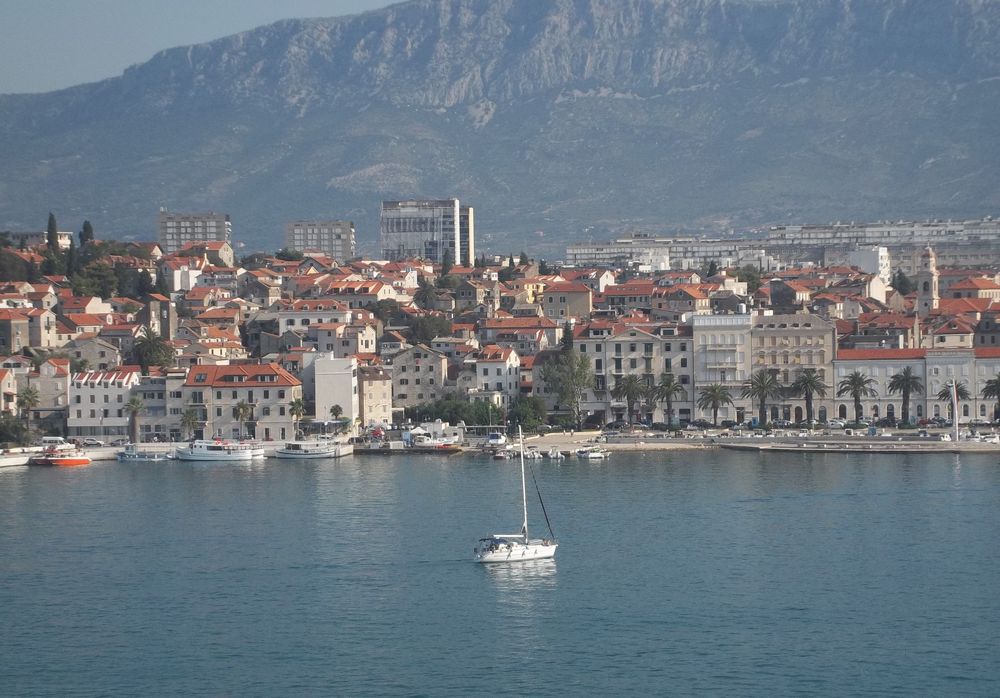
Smoke from major wildfires in Bosnia and Herzegovina has again affected air quality in Split and across Dalmatia, with the Croatian city returning to the red category on the official air quality map.
After conditions appeared to improve during the morning, concentrations of airborne particles in Split began rising again, with the city once more marked red, indicating poor air quality.
The latest development was reported by Dalmacija Danas on Monday morning, as smoke from large fires in neighbouring Bosnia and Herzegovina continued to drift towards the Croatian coast.
The main fire affecting central Dalmatia is burning in an area between Tomislavgrad, Prozor-Rama and Kupres, where large areas have been affected by fire.
According to Croatia’s official air quality monitoring portal, the red category indicates poor air quality. However, the classification does not necessarily reflect only the latest hourly measurement. The air quality index for PM10 and PM2.5 particles is calculated using a rolling 24-hour average, meaning the red classification can remain even after hourly concentrations begin to fall.
High particle concentrations recorded in Split
Air quality in Split deteriorated sharply on Sunday.
At the Split-2 monitoring station, PM10 concentrations reached 144.30 micrograms per cubic metre at 11am, while the measurement at noon was 119.07 micrograms.
Concentrations fell considerably overnight and during the early hours of Monday, but the subsequent rise highlighted how quickly conditions can change depending on wind direction and strength.

Croatia’s official air quality monitoring portal (Dalmacija Danas)
Earlier on Monday, measurements at another Split station showed substantially lower hourly concentrations, although the 24-hour average remained elevated.
The Croatian fire service has confirmed that the smoke affecting Dalmatia is coming from major fires in Bosnia and Herzegovina.
Smoke carried towards the Croatian coast
The major fire near Zvirnjača in the Kupres area, which broke out on 4 September, subsequently spread towards Ljubuša, Tomislavgrad and Prozor-Rama.
The fire has affected a vast and difficult-to-access area. Earlier reports put the area burned around Tomislavgrad at approximately 14,000 hectares.
Two Croatian Canadair firefighting aircraft were also involved in operations in Bosnia and Herzegovina, helping prevent the fire from threatening settlements in the Prozor-Rama area.
Strong and changeable winds have complicated firefighting operations while also influencing the movement of smoke towards the Adriatic.
The Croatian Meteorological and Hydrological Service (DHMZ) said the bura wind contributed to transporting smoke from Bosnia and Herzegovina towards the Adriatic coast.

(Dalmacija Danas)
Smoke and the smell of burning were reported across a wide part of Dalmatia, including Split, Šibenik, the islands and the Dubrovnik area. The Croatian Firefighting Association confirmed that smoke was being carried by wind from several active fires in Bosnia and Herzegovina.
Advice for residents
Health authorities have advised residents to take precautions while concentrations of airborne particles remain elevated.
The Teaching Institute of Public Health of Split-Dalmatia County previously reported that PM10 and PM2.5 concentrations had risen several times above usual levels in parts of the county, including on the islands.
Particular caution has been advised for children, older people, pregnant women and people with respiratory or cardiovascular conditions.
Residents are advised to reduce time spent outdoors and avoid strenuous physical activity while heavy smoke is present. People experiencing irritation of the eyes or throat, or breathing difficulties, should take particular care.
The Croatian Firefighting Association has also asked residents to keep windows closed during periods of heavy smoke and to follow instructions from the relevant authorities.
Air quality conditions can be monitored through Croatia’s official Air Quality portal, where current measurements and air quality classifications from monitoring stations are published.
The situation remains dependent on the movement of smoke and changing wind conditions, meaning air quality can improve or deteriorate relatively quickly.