Rare face-down Roman burial discovered at ancient Croatian town
- by croatiaweek
- in News

(Photo: Archaeological Museum in Split)
Archaeologists have uncovered an unusual Roman burial in which the deceased was placed face down during the latest excavations at the ancient city of Salona near Split.
The discovery was made during the fifth season of archaeological research at part of Salona’s western necropolis, known as Hortus Metrodori.
This year’s excavations investigated 32 graves, bringing the total number of graves examined at the site to 152. The newly investigated graves consisted of 16 cremation burials and 16 inhumation burials.

(Photo: Archaeological Museum in Split)
Unusual burial
The most notable discovery was Grave 162, which stood out both for the quantity of objects found inside and the position of the deceased, who had been laid on their stomach.
The grave contained three glass bottles, a small glass vessel and three glass unguentaria, small vessels commonly associated with perfumes, oils or other substances.

(Photo: Sara Popović/Archaeological Museum in Split)
One of the unguentaria was particularly distinctive, being shaped like a date.
Archaeologists also recovered four ceramic vessels, two engraved gems and parts of a bronze object.
The grave was located over the remains of an earlier destroyed wall. Researchers had previously considered the structure to be the northern wall of a funerary plot bordered on its southern side by a murazzo, or substantial masonry wall.

(Photo: Archaeological Museum in Split)
The presence of first-century graves above the earlier wall suggests that the structure may have been constructed before the murazzo itself.
The findings therefore provide additional information about the development and organisation of this part of Salona’s necropolis.

(Photo: Sara Popović/Archaeological Museum in Split)
The excavations were carried out by the Croatian Conservation Institute (Hrvatski restauratorski zavod) and the Archaeological Museum in Split, with bioarchaeological analyses conducted by the Anthropological Centre of the Croatian Academy of Sciences and Arts.
The programme is funded by Croatia’s Ministry of Culture and Media.
Cremation burials
The excavation also revealed a range of Roman cremation practices.
Of the cremation graves, the most common were those in which the cremated remains were placed directly into a pit, with 12 examples recorded.
Three cremation burials contained ceramic urns, while another used a stone urn.

(Photo: Sara Popović/Archaeological Museum in Split)
The graves were often marked by vertically positioned worked stones.
Among the cremation burials, Grave 137 was of particular interest. It contained a glass unguentarium, a bone needle and a ceramic oil lamp.
The combination of cremation and inhumation graves provides further evidence of changing burial practices at Salona over time.
Salona, located near present-day Solin, was the capital of the Roman province of Dalmatia and one of the most important urban centres on the eastern Adriatic.
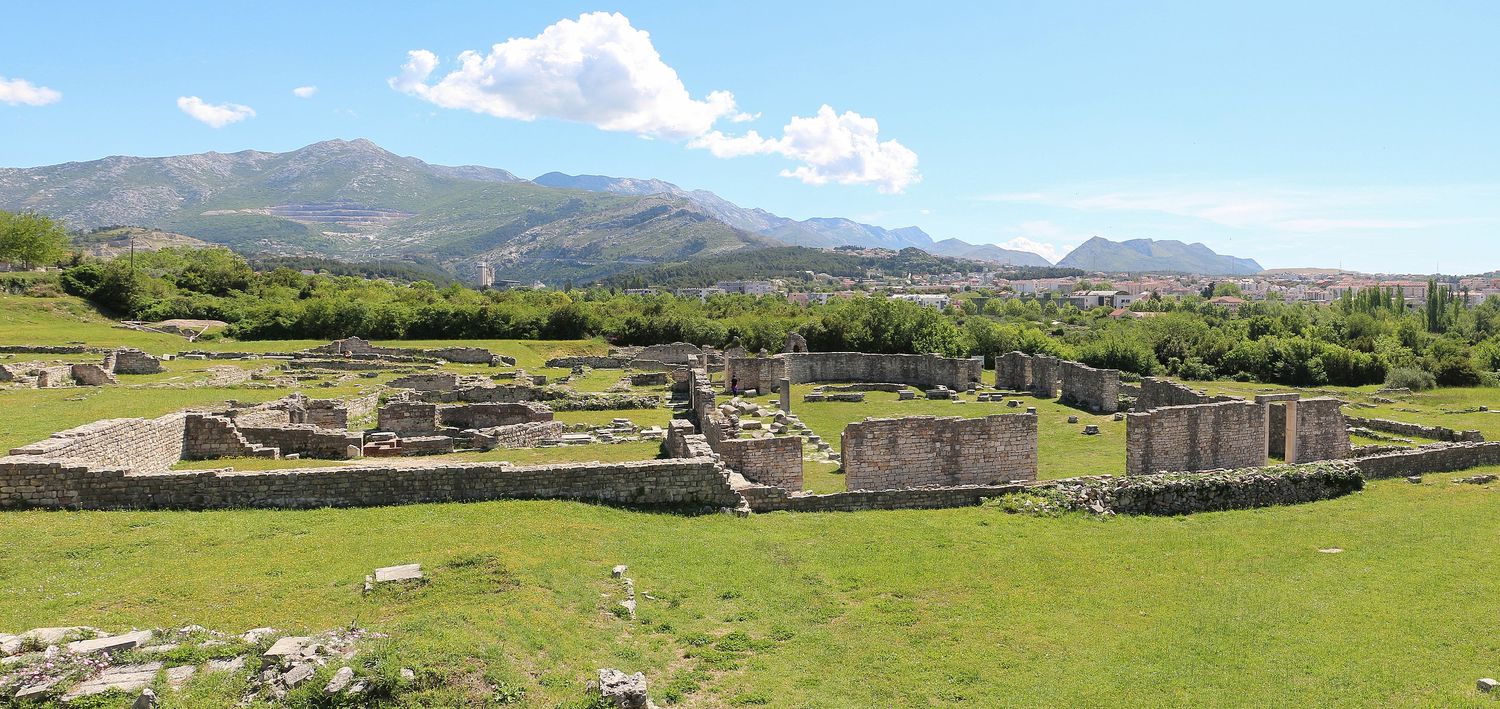
Salona site (Photo credit: Bernard Gagnon/CC BY-SA 4.0)
Its extensive archaeological remains offer insight into Roman life, architecture, religion and funerary customs in the region.
The latest research at Hortus Metrodori is being conducted by a multidisciplinary team involving archaeologists, students, support staff and specialists in bioarchaeology.
Researchers say the results demonstrate the importance of cooperation between Croatian cultural and scientific institutions in documenting and interpreting the ancient site.