Croatian scientists solve long-standing mystery about how human cells divide
- by croatiaweek
- in News
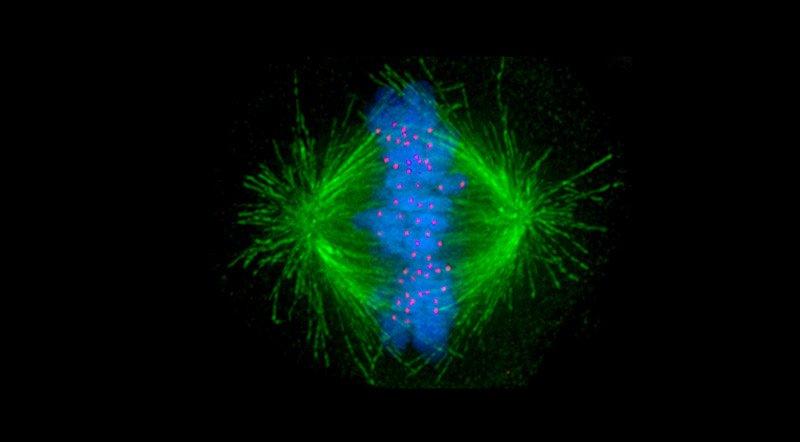
Image source: Nature Cell Biology – original research
Scientists at the University of Zagreb have helped solve a long-standing mystery in cell biology, explaining how cells maintain the correct size of a structure responsible for separating chromosomes during cell division.
The research was carried out by scientists from the Faculty of Science in Zagreb, in collaboration with researchers at the University of Geneva in Switzerland.
The findings, published in the prestigious scientific journal Nature Cell Biology, mark the culmination of a six-year research project worth €10 million, funded by the European Research Council (ERC).
The project, known as ANEUPLOIDY, was the first ERC Synergy project awarded to researchers and institutions in Croatia. It was led by academician Professor Iva Tolić of the Ruđer Bošković Institute, Professor Nenad Pavin of the University of Zagreb’s Faculty of Science, and Professor Geert Kops of the Hubrecht Institute in the Netherlands, with contributions from researchers at the Massachusetts Institute of Technology (MIT) in the United States.
The international team investigated how cells manage to distribute their chromosomes correctly during division, despite enormous differences in the amount of DNA found in different organisms.
By studying 25 evolutionarily diverse species, researchers discovered that the amount of genetic material, rather than the number of chromosomes, determines the space in which chromosomes are organised before being separated into two new cells.
They found that as the amount of DNA increases, the area occupied by chromosomes within the cell’s division machinery, known as the spindle, also expands. Forces generated between chromosomes help shape and enlarge this space.
Scientists from the University of Zagreb’s Faculty of Science played an important theoretical role in the research, developing physical and mathematical models that were subsequently tested through experiments on living cells.
The findings could help explain how organisms have adapted to major changes in genome size throughout evolution, including whole-genome duplication events associated with the emergence of new species.
The research may also have implications for understanding cancer. Tumour cells can tolerate substantial changes in DNA content, but the study suggests this adaptability has mechanical limits. Understanding those limits could eventually help identify ways to selectively target cancer cells with enlarged genomes.
The ANEUPLOIDY project employed 15 researchers and produced 41 scientific papers over six years, with Croatian scientists holding key authorship roles on 30 of them.