
PHOTOS: First hybrid train on Zagreb–Split route begins
- by croatiaweek
- in News
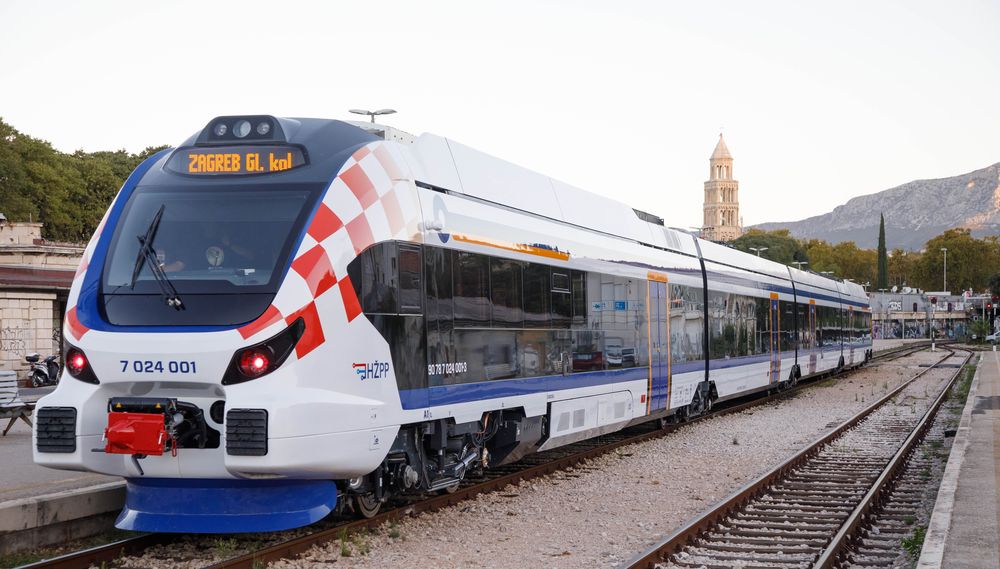
(Photo: HŽ Passenger Transport)
ZAGREB, 15 September 2026 (Croatia Week) – Croatia has introduced its first hybrid electric-diesel passenger train on the Zagreb–Split route, designed to operate on both electrified and non-electrified sections of the railway.
The new train entered service today, marking the first of six hybrid trains being introduced as part of a wider investment in Croatia’s rail passenger transport.
Built to meet the specific conditions of the Zagreb–Split railway, the train can operate using electric power on electrified sections and diesel power where there is no overhead electrification.
The 429-kilometre route between the Croatian capital and Split is currently electrified from Zagreb to Oštarije, a distance of 103 kilometres. The remaining 326 kilometres to Split are not electrified.

(Photo: HŽ Passenger Transport)
The new train has 150 seats and features free Wi-Fi, power sockets, a modern passenger information system, visual and audio announcements, accessibility ramps and dedicated bicycle space.

(Photo: HŽ Passenger Transport)
Passengers can also use self-service machines offering coffee and other hot drinks, water, soft drinks, sweets and snacks.
The project involves the production of six electric-diesel trains, financed through a €57.3 million loan from the European Investment Bank (EIB).

(Photo: HŽ Passenger Transport)
HŽ Passenger Transport said five additional trains of the same type are expected to enter service by the end of the year. From December, the operator plans to introduce more services between Zagreb and Split, including two daily trains from each city, as well as a night train on Fridays from Zagreb and Sundays from Split.

(Photo: HŽ Passenger Transport)
State Secretary for Railways Žarko Tušek said the new trains represented a step towards improving connections between Zagreb and Dalmatia. He added that study documentation for the Zagreb–Split railway is expected to be completed next year and will examine technical solutions for the development of the wider rail corridor.
The train was developed and produced by Croatian technology company KONČAR in cooperation with dozens of Croatian companies. According to KONČAR, the trains were developed in line with international standards and modern technological requirements.

(Photo: HŽ Passenger Transport)
KONČAR President and CEO Gordan Kolak said the bimodal train demonstrated the expertise and innovation of Croatia’s domestic rail industry. A second train from the series is due to be presented next week at InnoTrans in Berlin, one of the world’s leading transport technology trade fairs.

(Photo: HŽ Passenger Transport)
The EIB is providing wider financial support for Croatia’s railway sector. According to EIB Vice-President Marko Primorac, €900 million is available for investment in railways and related infrastructure in Croatia. This includes financing for a further 13 trains, as well as the renovation of local and regional railway lines and railway stations.

(Photo: HŽ Passenger Transport)
The investment is also intended to improve energy efficiency in passenger transport, while reducing noise and greenhouse gas emissions and making rail travel a more competitive alternative to road transport.
The launch comes as Croatian authorities continue to examine longer-term improvements to the Zagreb–Split rail corridor, with regional and local officials highlighting the importance of faster and more reliable rail connections for residents and tourists.


