Croatia plans €6 billion railway investment as speed limits persist
- by croatiaweek
- in News

ZAGREB, 29 September 2026 (Hina) – Croatia plans to invest around €6 billion in its railway network by 2035 as the country seeks to increase train speeds, improve reliability and expand capacity across its main routes.
The planned investment comes as speed restrictions remain in place on 237 kilometres of Croatia’s railway network, according to HŽ Infrastruktura and the Ministry of the Sea, Transport and Infrastructure.
Croatia has 2,617 kilometres of railway lines, of which 166 kilometres are currently out of service. Around 400 kilometres are double-track, including the Dugo Selo–Križevci and Križevci–Koprivnica–state border sections, where major projects are nearing completion.
According to HŽ Infrastruktura, speed restrictions are primarily linked to the condition of infrastructure, as well as ongoing reconstruction, modernisation and maintenance works.
Among the routes that generated the most passenger-train delay minutes during 2025 and 2026 were Zagreb–Koprivnica, Zagreb–Osijek and Zagreb–Split.
Faster trains planned
The modernisation programme is intended to enable passenger trains to reach speeds of up to 160 km/h on international routes, 120 km/h on regional lines and 80 km/h on local routes.
However, HŽ Infrastruktura says shorter journeys will not depend solely on higher speeds.
The construction of second tracks on currently single-track sections is also expected to reduce waiting times caused by trains having to pass one another, which can significantly extend journey times.
The government says railway investment is currently at its highest level in Croatia’s history. More than €2 billion has been invested over the past decade, with investment in 2025 almost five times higher than in 2017.
A further €6 billion is planned through 2035.
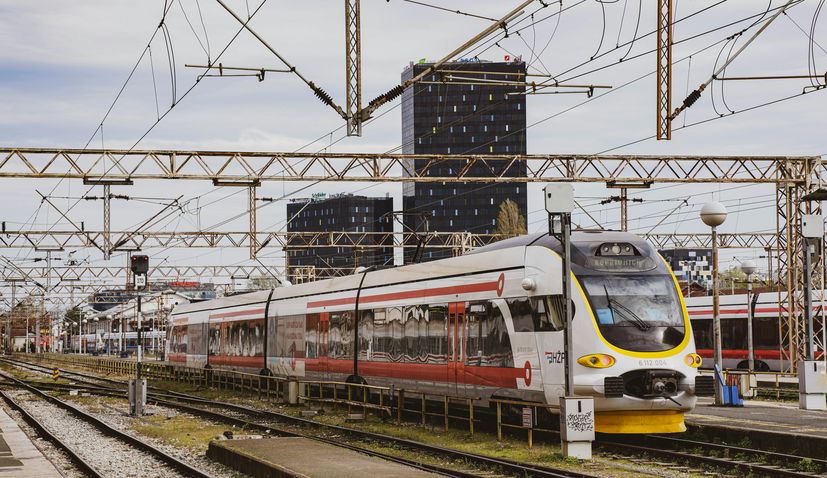
Zagreb
Among the key projects are the reconstruction and construction of second tracks on the Križevci–Koprivnica–state border, Dugo Selo–Križevci and Hrvatski Leskovac–Karlovac sections.
A contract worth almost €700 million is also expected for works on the Dugo Selo–Novska section, which would become Croatia’s largest individual railway project.
Major projects nearing completion
Work on the Dugo Selo–Križevci section is 99% complete, with remaining works concentrated mainly around Dugo Selo railway station. Completion is planned by the end of 2026.
The project experienced several delays, including financial difficulties involving contractors. Following the exclusion of DIV Grupa from the consortium in 2024, Dalekovod took over the works, which subsequently accelerated.
The Križevci–Koprivnica–state border project is also approaching completion. Construction is expected to finish by the end of this year, followed by installation and testing of signalling and safety systems, technical inspections and operating permits.
A gradual increase towards the planned maximum speed of 160 km/h is expected to begin with the 2026/27 timetable.
HŽ Infrastruktura has attributed delays on major projects to factors including the coronavirus pandemic, the war in Ukraine and difficulties in sourcing materials. Landslides also caused additional problems on the route towards the Hungarian border.
Many works are being carried out while passenger and freight services continue to operate.
Focus on Rijeka and the lowland railway
A significant part of future investment is connected with improving rail links between Rijeka, Zagreb and the Hungarian border.
Design work is under way for the planned lowland railway sections Karlovac–Skradnik and Skradnik–Krasica–Tijani. Applications for location permits are expected by the end of 2026.
The value, financing sources and construction timetable will be determined after the designs and an assessment of market prices have been completed.

Preparatory works are also under way on the Hrvatski Leskovac–Karlovac section.
The project includes reconstruction of 44 kilometres of existing track, construction of a new track, electrification, signalling and telecommunications upgrades and reconstruction of stations in Hrvatski Leskovac, Jastrebarsko and Karlovac. Completion is planned for 2029.
Regional and local lines included
The investment programme also covers railway lines outside the main European corridors.
Works are under way on routes including Knin–Zadar, Čakovec–Varaždin–Koprivnica–Kloštar, Pitomača–Kloštar, Banova Jaruga–Daruvar, Osijek–Koška and several lines in Istria.
For the 2026–2028 period, planned investment amounts to €1.4 billion. Of this, €232 million is earmarked for regional railways and €84 million for local lines.
The ministry says railway modernisation faces a number of challenges, including lengthy project preparation, a shortage of designers, property-rights issues, permitting procedures, changes to spatial plans and complex public procurement and appeals processes.
The fact that much of the work must be carried out while railway traffic continues is another factor affecting the pace of construction.
According to the ministry’s current plans, the major projects now in preparation or under construction should be completed by 2035.
The aim is to create a significantly upgraded railway network capable of providing faster and more reliable passenger services while increasing safety and the overall capacity of Croatia’s rail system.